Attila İlhan wrote one of the most-quoted love poems in Turkish about a woman he never spoke to. He saw her on a ferry, travelled as far as Naples in her company without ever approaching her, and built out of that silhouette an entire history — a rival, a harbour, three stanzas of jealousy. Then he titled the poem for his own position in the story he was telling: Üçüncü Şahsın Şiiri, the third person's poem.
Which makes it, among other things, a very precise piece of character writing. The woman at the centre of it is almost entirely invented, and the poem is honest about that in a way its reputation as a love poem tends to hide.
The silhouette
We know the circumstances because İlhan described them himself, in the closing pages of the same book the poem appears in — Yağmur Kaçağı, 1955. There was a girl who lived around Maçka — slim, short-haired, studying at the academy of fine arts, as he recalled it. By coincidence they were on the same boat on one of his Marseille crossings. He never found a way to speak to her.
“Siluet diyorum çünkü kişi olarak onu tanımadım; ama galiba uzaktan ‘sevdim’.” I say silhouette, because I never knew her as a person — but I think I loved her, from a distance.
Read the poem after that and its emotional machinery changes shape. The rival, the cigarette, the cold look, the nights that end like novels — none of it is recollection. It is construction. A writer has taken the one thing he actually had, a figure glimpsed at a distance, and extrapolated a relationship he was never in.
A title that names its own narrator
Üçüncü şahıs does double duty. It is the grammatical third person, and it is the third party in a triangle — the one standing outside a couple, watching. İlhan titles the poem for both at once, which tells you before the first line that the speaker knows he is not a participant.
There is a quieter signal in the grammar itself. Almost every verb in the poem is in the Turkish habitual past — olurdu, ağlardım, gülerdi, yatardı: it would happen, I would weep, they would laugh. Not this happened. This used to happen, over and over. The poem never describes a night. It describes a loop.
That tense choice does something no amount of imagery could. It makes the jealousy habitual rather than acute — a condition the speaker lives inside, not an event he survived.
The rival, in five words
The first stanza establishes the triangle and the speaker's position in it: she does not love him, he knows it, he has heard there is someone else. He accepts all of this. What he will not accept is the other man.
Çöp gibi bir oğlan ipince A boy like a twig, thin as thread.
Five words, and the rival is finished. He is not described as cruel or unworthy in any way that would require argument — he is described as thin. The insult is pure physical contempt, and it is the first evidence that the speaker's judgement is not to be trusted. He has no access to this man either. The rival is as invented as the woman.
The stanza ends where all three stanzas end, with the line that holds the poem together:
Felâketim olurdu ağlardım It would be my catastrophe — and I would weep.
Again: olurdu, ağlardım. Not once. Every time.
The city does the feeling
The second stanza drops the rival entirely and turns to the woman and the place she lives. It is the warmest passage in the poem, and the speaker never once says he is happy. He describes Maçka instead — the harbour always full of ships, a wind that takes his mind.
Ağaçlar kuş gibi gülerdi The trees would laugh like birds.
The emotion is displaced outward onto the district until the trees are doing it for him. This is how the poem keeps its speaker at third-person distance even in its most intimate moment: he will not claim the feeling in the first person, so he gives it to the landscape.
It does not hold. She lowers her eyelashes, looks at him, and the chill returns. The refrain closes the stanza exactly as before — because in the habitual past, it always does.
Jezebel
The third stanza opens with the poem's strangest move. In the middle of an Istanbul love poem, with no preparation, a name arrives from the Book of Kings.
Jezabel kan içinde yatardı Jezebel would lie there in blood.
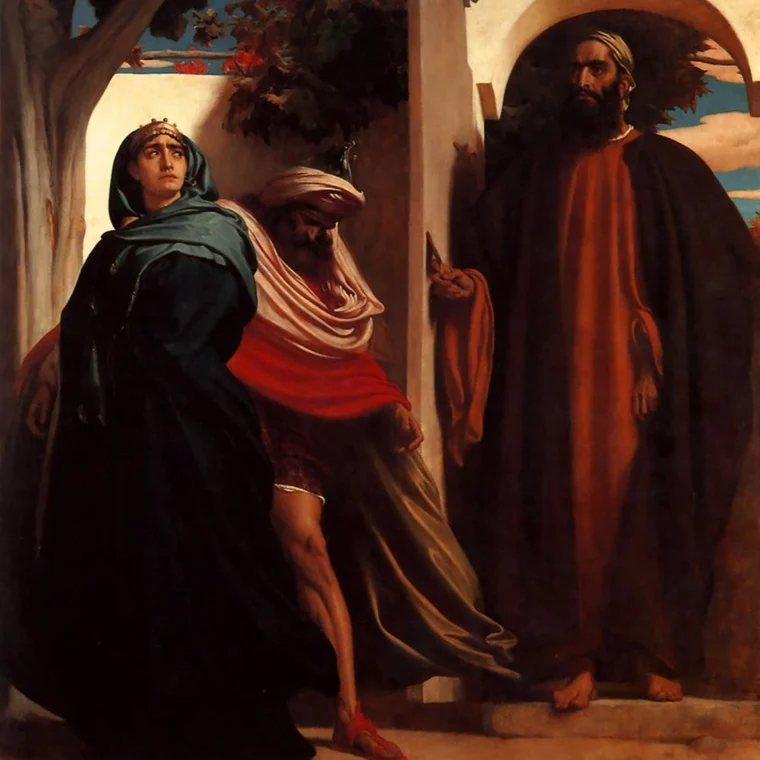
Jezebel is the daughter of Ethbaal of Sidon and the wife of Ahab, king of Israel. She is scripture's archetype of the woman who sets herself against the sacred order of men, and her end is written to make the lesson unmistakable: thrown from a window, trampled, and eaten by dogs, so that nothing remains to bury. The warning she carries forward to every disobedient woman after her is that an unchaste, unbelieving, unyielding life earns a death not even fit for a grave.
Dropping that name here is not decoration. The speaker is reaching past his own situation for a punishment at scale — and the violence of the reach tells you how little the real woman has to do with any of it. She has not wronged him. She does not know him. He is, by his own account, a silhouette's distance away. And he summons an execution.
It is the moment the poem's sympathy quietly shifts. Up to here the speaker has been a sad figure. Here he becomes a slightly frightening one, and the poem lets you notice without ever saying so.
Whose funeral
The rest of the stanza watches from outside: she rises, she goes to him, she stays until morning. The speaker consoles himself by noting how pale she looks on the way — a face like a candle. Then he turns to the rival one last time and says that when the man laughs, he looks like a funeral.
He means it as contempt. It reads as something else. The only death in this poem belongs to the man watching it, and the funeral he sees in another man's laugh is his own.
What the poem is actually doing
Take the three things together — a subject the writer never met, a title that admits the speaker stands outside the story, and a tense that makes the whole affair a loop rather than an event — and Üçüncü Şahsın Şiiri stops being a poem about unrequited love. It becomes a poem about the construction of unrequited love: someone assembling an entire emotional history out of almost no material, and narrating it in a grammatical person that keeps announcing he is not in it.
Which is, more or less, the job. You are given a glimpse of someone, and you build a person out of it, and you choose the distance you are going to stand at while you tell it. İlhan did it with a woman on a boat to Naples and never corrected the record. He just put the method in the title.
Prose quotation: Attila İlhan, from the closing pages of the same volume.
Image: Frederic Leighton, Jezebel and Ahab (1863), public domain.
Translations are mine.