This traces one player through one game, in four stages — discovery, onboarding, habit building, mastery. The player is me, which makes it a small sample, but it also means every claim here is something I can show rather than assume. What the trace turns up is that Hades II spends an unusually long time on its second stage and an unusually strange one on its fourth: it onboards the same player three separate times, and then hands mastery not to the player with the best reflexes but to the player who has read its probability tables.
Discovery: sold before a single frame of gameplay
The reveal trailer aired at The Game Awards in December 2022. I was in on the sequel before I knew anything about it — not because the trailer was persuasive, but because of two things that happened years earlier.
In 2017 the Epic Games Store gave away Transistor. It has been my favourite game ever since. In 2020 Supergiant took Hades out of Early Access, and it turned out to be a roguelite that told a story through its own repetition rather than in spite of it. By the time the Hades II trailer played, the studio had spent six years building the only thing that actually matters at the discovery stage: the player's prior.
This is worth stating plainly because it is the part of the funnel a design team has the least direct control over on the day. Discovery for Hades II was not won by the trailer. It was won by Transistor and Hades, and the trailer only had to collect.
Onboarding: three attempts across three builds
Here is where a tidy funnel diagram stops matching reality. I did not onboard once. I onboarded three times, across three builds, and quit twice.
The technical test. Supergiant opened a technical test and I got in. The game was not ready to be enjoyed and was barely ready to be tested — which is exactly what a technical test is for, and exactly the wrong first contact for a player arriving on six years of goodwill. I nearly stopped there.
The first Early Access patch. Four Underworld regions and one Surface region. Enough of a shape to see what the game wanted to be, not enough to stay in. I played, I saw the edges, I quit again.
The third Early Access patch. Two major updates later, I gave it another shot. The endgame still was not in, and I was having an enormous amount of fun anyway. That was the run that stuck.
So: three separate onboardings for a game I was predisposed to love, two of which failed. That is the real cost of shipping in Early Access, and it is a cost paid specifically in the onboarding stage. Every patch is a fresh first impression for a returning player, and two of my three first impressions were bad ones. The build that finally converted me was not the one with the most content — it was the first one whose moment-to-moment play felt finished, even with the endgame missing.
That ordering matters. A player will forgive absent content. They will not forgive content that does not feel good to touch.
Habit building: learning the vocabulary
Past onboarding, becoming competent at Hades II means learning three overlapping systems, none of which the game explains all at once.
Arcana. Melinoë's persistent upgrades are a grid of tarot cards, each costing Grasp from a limited pool, so every loadout is a budget. Some cards also carry positional conditions — The Fates only works if the cards around it are active — which turns the grid from a shopping list into a small layout puzzle you re-solve whenever your Grasp increases.
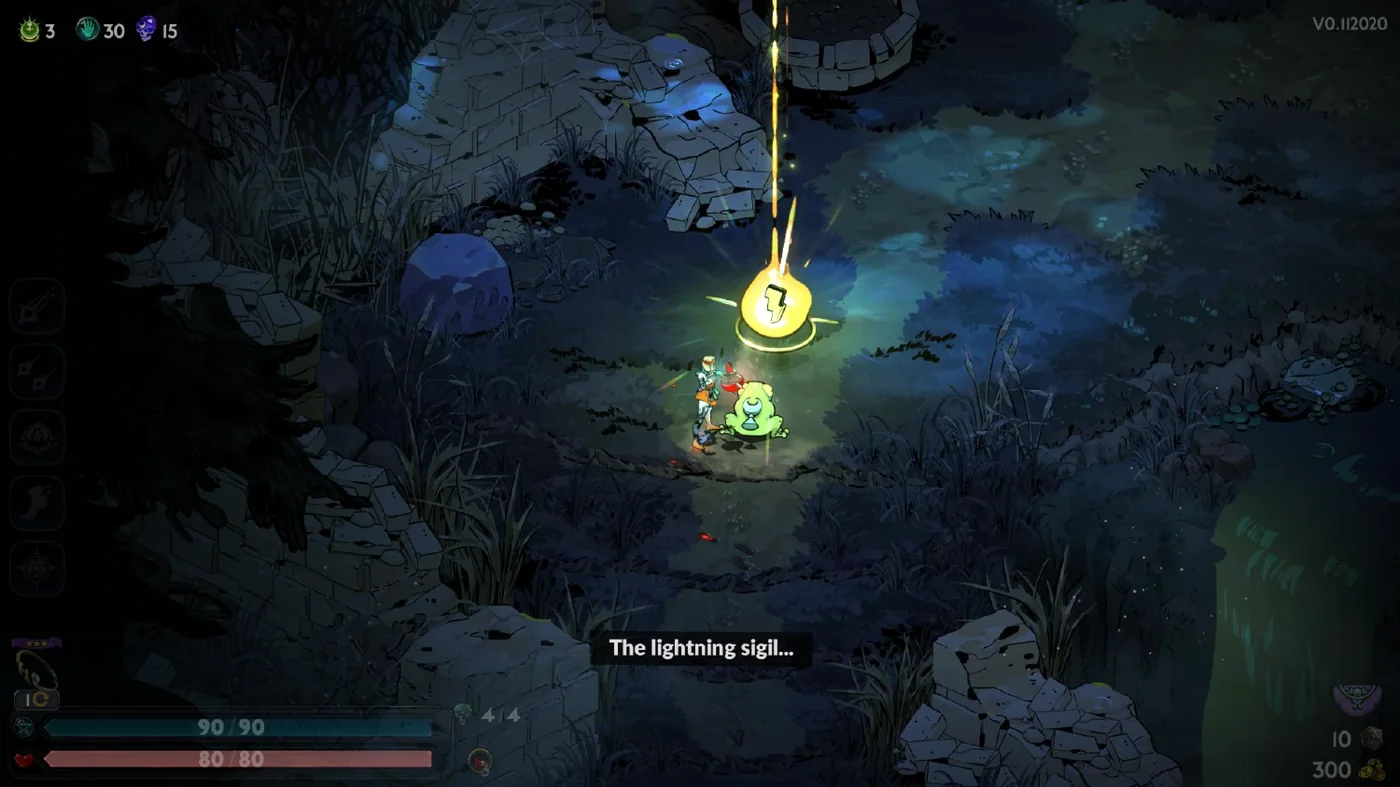
Weapons. Six Nocturnal Arms, three aspects each: eighteen distinct weapons, each wanting different boons.
Boons. Unlike the first game, every Olympian shows up, and which ones can appear is governed by rules rather than by a flat shuffle. This is the system that eventually swallows the other two, and it is the one the mastery stage is really about.
Mastery: the difficulty curve is a knowledge curve
Beating Chronos and Typhon is the end of the story, not the end of the game. Past that sits the Oath of the Unseen — a stack of optional vows you switch on yourself, each adding Fear, the game's difficulty counter.
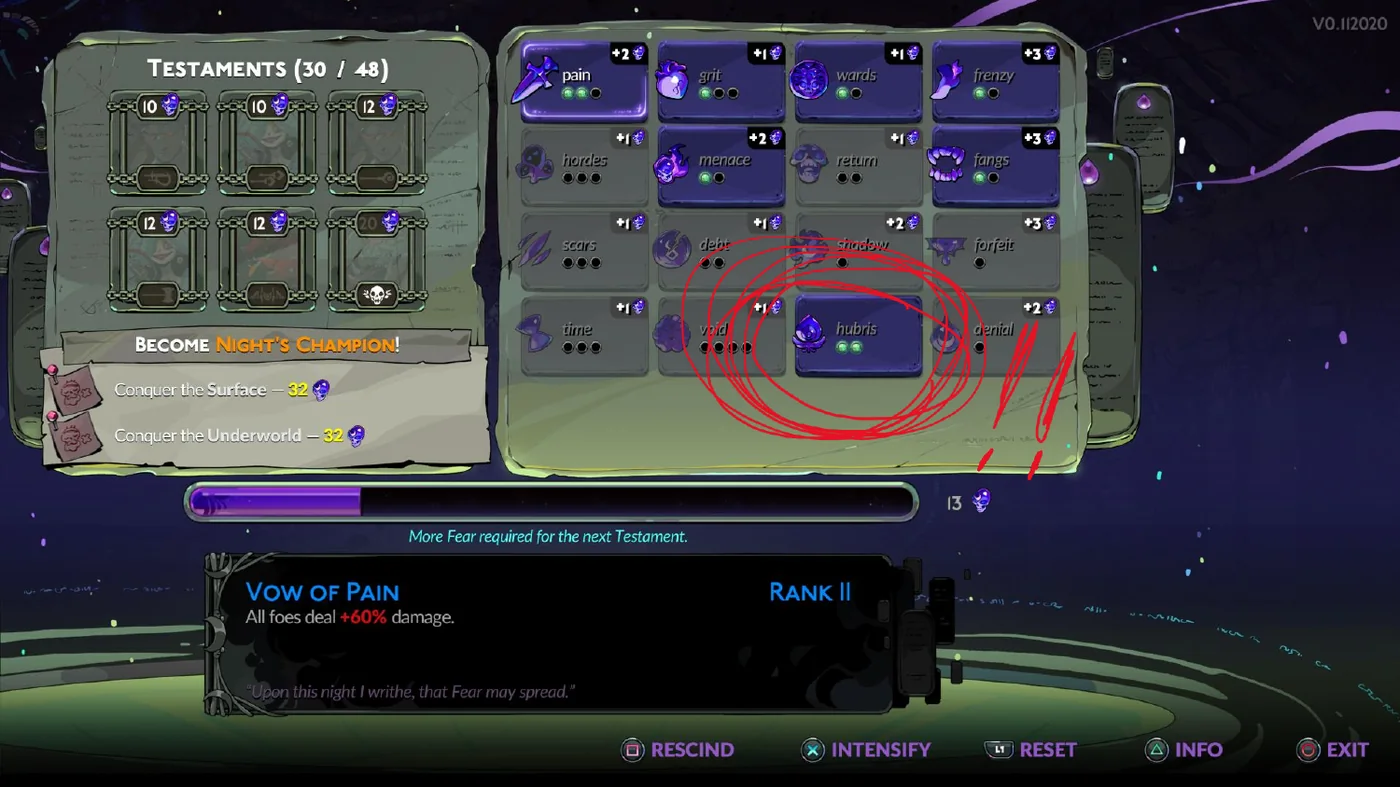
Runs at 0–16 Fear are a matter of competence. Around 32 the game stops forgiving loose play. Past that, the curve bends hard enough that the difference between the players who clear it and the players who do not is no longer execution at all.
What separates them is this: at high Fear, Hades II is a game about manipulating its own random number generator, and the players who win are the ones who understand how it is weighted.
Two things make that possible. The first is that the game's resource files are readable, so the probabilities are not a mystery to be inferred over hundreds of runs — they are a table you can look up. The second is the reroll, which turns a bad offer into a second draw from a pool you already understand. Arcana like Cloud Bangle tilt the pool before you ever reach a door. Specific regions and encounters have their own quirks on top.
None of that is cheating, and none of it is hidden. It is simply a layer of the design that the game never teaches, and the fourth stage of the journey is the stage where you go and learn it yourself.
One run, decided move by move
An example, because the claim above is easier to show than to argue.
The target for this run is Shocking Loss — a Legendary boon of Zeus, the kind that is not offered, only earned. Legendary boons sit behind prerequisite boons, and the requirements panel tells you exactly which ones.
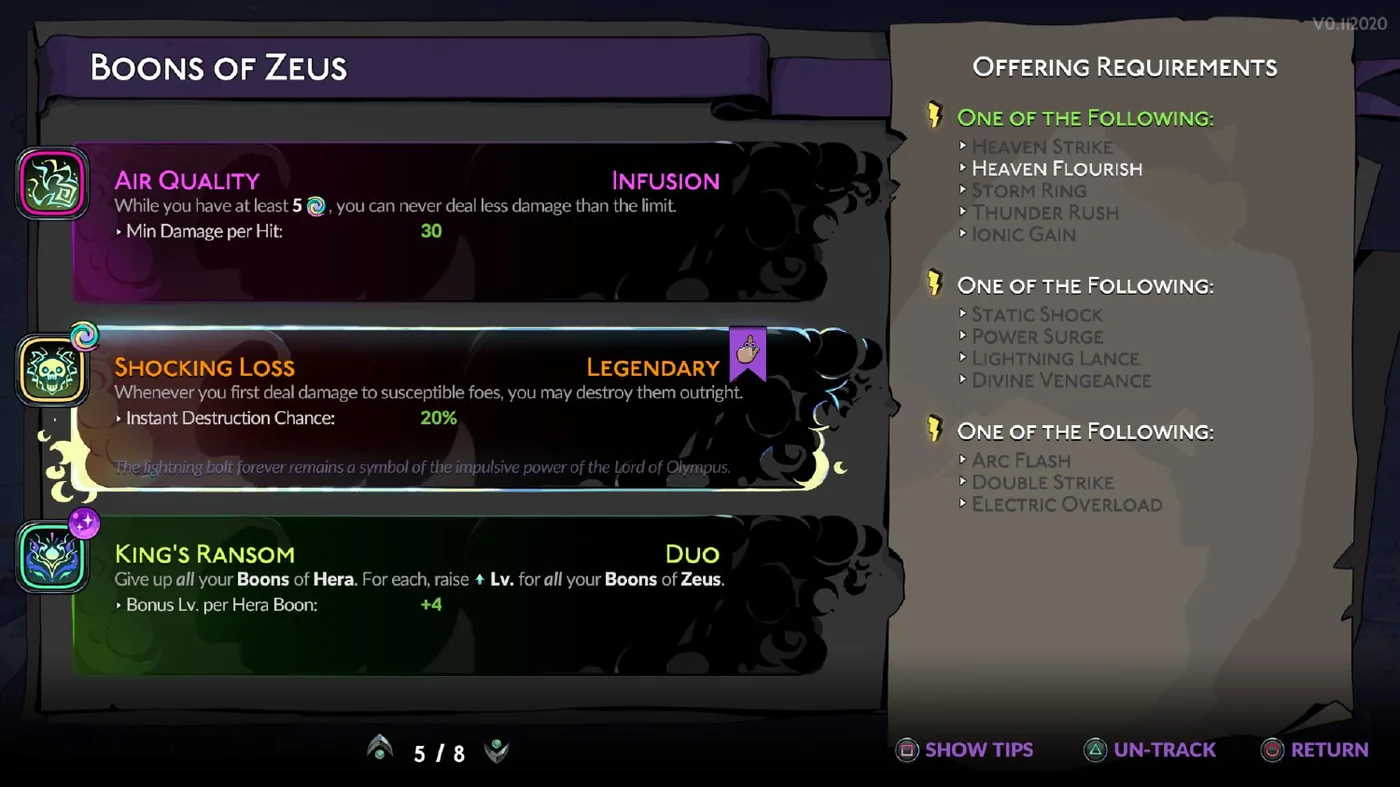
So the run is not "hope for a good drop." It is: tilt the pool toward Zeus with Cloud Bangle, track the boon so the game tells me when I am close, then route through the map taking the doors that keep the chain alive and rerolling the ones that do not.
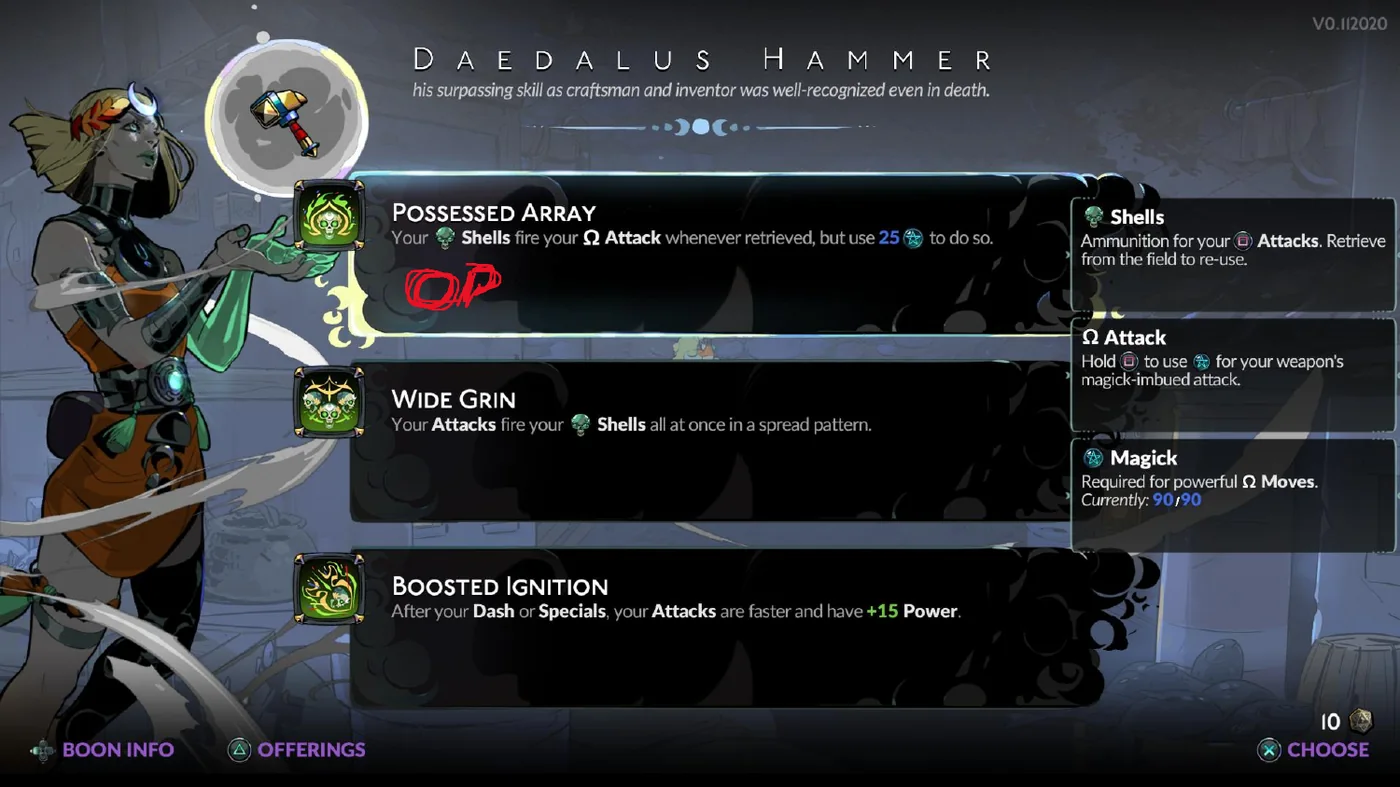
That means judging every offer against the plan rather than against its own card text. A Daedalus Hammer upgrade that would be excellent in a vacuum is the wrong pick if it pulls the build sideways — and one that reads as modest is the right pick if it keeps the chain intact.
Routing carries the same weight. Doors are labelled with what is behind them, so choosing a path is choosing which pools you will draw from and how many draws you get before the region ends.
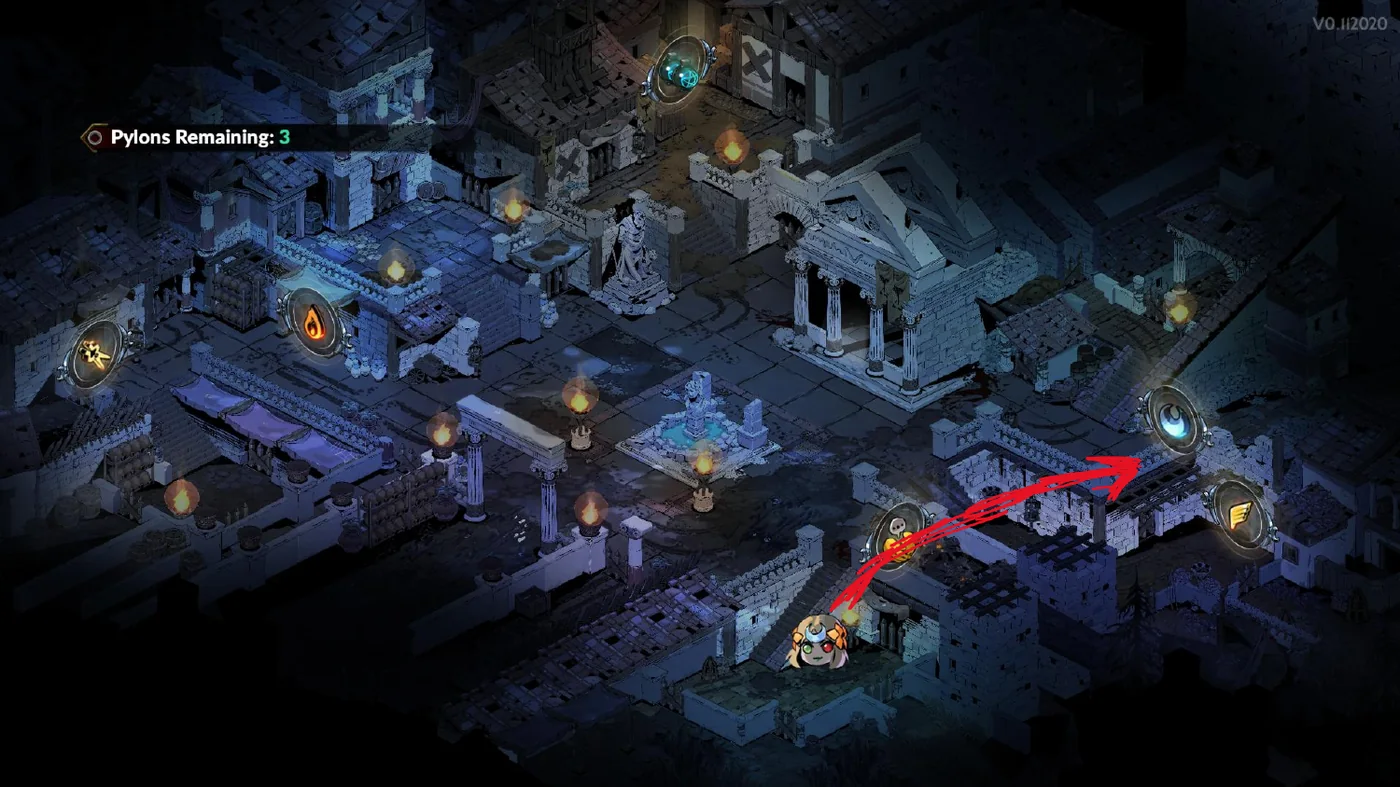
Zeus and Poseidon both spent the early region offering me things I did not need. It did not matter. The pool was already tilted, the chain was tracked, and the rerolls were there to spend.
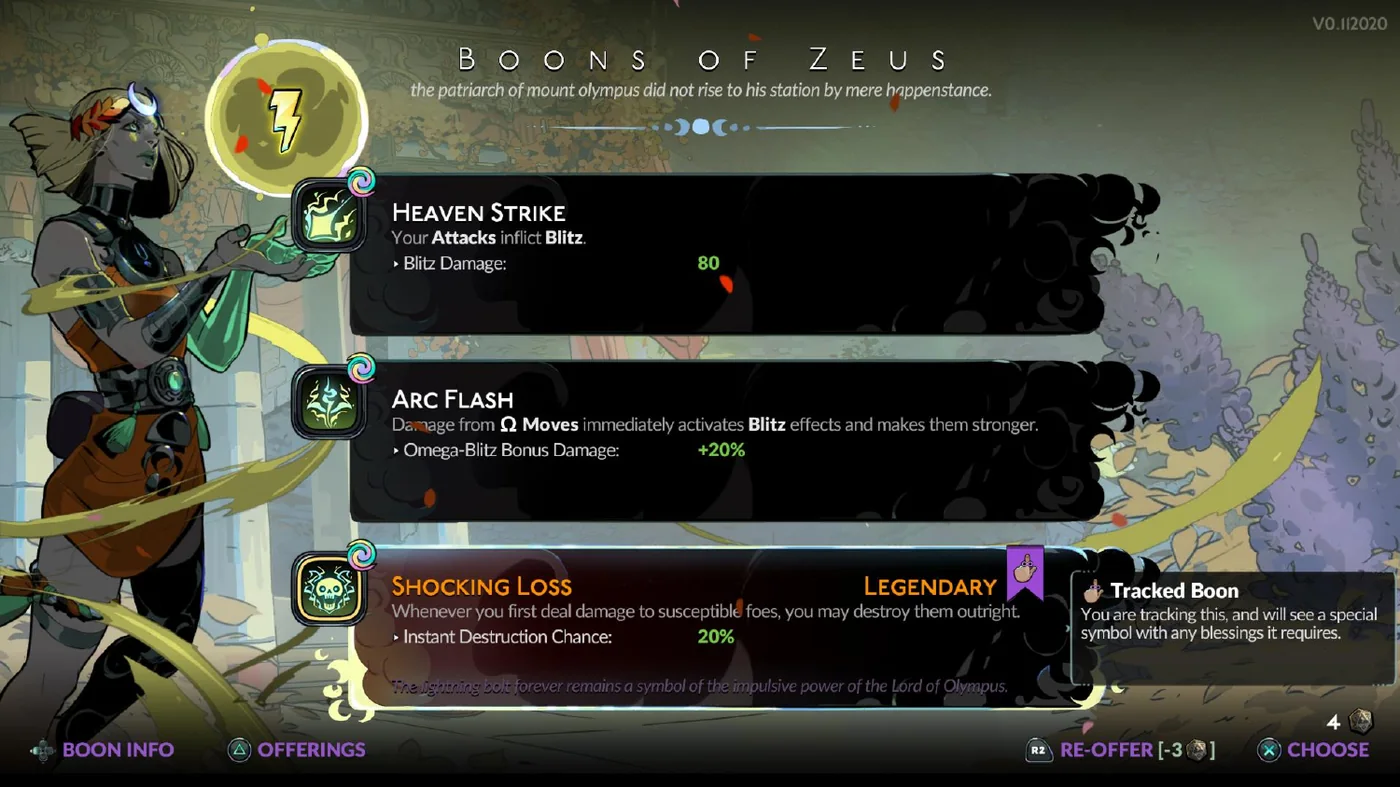
Three boon-giving doors. On a different route, with the same cards and the same luck, it would have taken far longer or not happened at all.
What the journey shows
Read back as a whole, the four stages do not describe a player gradually getting better at pressing buttons.
Discovery was decided by two previous games. Onboarding took three attempts and was finally won by feel rather than by content. Habit building was the slow acquisition of a vocabulary. And mastery turned out to be a research problem wearing an action game's clothes — god pools, boon types, rarities, minor and major finds, and what a reroll actually does to each of them.
That last stage is the interesting one for anyone designing this kind of game. Hades II never teaches its probability layer, never hides it either, and makes the whole top end of its difficulty curve depend on players going and finding it. It is a real design decision with a real cost: the players who never go looking hit a wall at around 32 Fear and read it as the game being unfair, when what they have actually run into is an unwritten syllabus.
Ataskion aski.